
The cornerstone
Social Accord Architecture
The founding text of the discipline: the complete methodology for building durable agreements between industrial projects and communities.
The method
A design discipline for the relationship between an industrial project and the people living next to it. Not a philosophy of engagement, and not a mediation technique. A specified architecture with five principles, four phases across the whole project lifecycle, and tests that have to be met before it advances.
The founding claim
Every project plan quietly assumes the relationship can carry weight: a resettlement, an expansion, a bad year, a mistake. Then it describes that relationship with words like "decent" and "improving", and never asks what it is rated to hold.
Treat it instead as what it is. Relational infrastructure bears load, and like any structure it has a capacity that can be exceeded. It decays, faster than concrete, because people rotate and memory fades and budgets get nibbled. And, this is the part that gives the discipline its name, it can be built. The capacity for agreement is buildable, surveyable, maintainable infrastructure.
Which turns the vague question into working ones. Who maintains this system, by name, with a budget? What is it rated to carry? When was it last inspected? A site that cannot answer those has an unmaintained asset holding up its production plan.
Why it had to be built
Every large industrial project creates the same collision. A company with timelines, investors and regulatory obligations on one side. Communities whose land, livelihoods and way of life sit in the project’s path on the other.
Handled by improvisation, the outcome is predictable: delays, distrust, protests, losses compounding on both sides. I watched capable people manage it on personality and stamina alone, and I watched what happened when those ran out.
The regulatory ground has moved too. The CSDDD, the German Supply Chain Act and the standards behind them now ask for evidence that engagement happened and grievances were resolved. Meanwhile community opposition has become the largest non-technical risk in mining and infrastructure, at 50 to 70 percent of net present value by research conducted from World Bank and IFC data. Most companies understand the problem. What they lack is a repeatable method.
The constitution
None of these was composed at a desk. Each one is a scar with a rule attached: a pattern of failure watched often enough, from close enough, that the countermeasure earned constitutional rank.
An engagement process is designed deliberately, and the design can be produced as a document before it is lived. Who is mapped, what the process intends to build, what it does when it fails. The violation is engagement assembled after the first roadblock: the task force formed in crisis week, the liaison hired because the protest made the news.
The method serves communities and projects at the same time, and the moment it appears to favor one it loses the other. Not splitting the difference, and not having no view. Visible neutrality of process, because neutrality that exists only in the practitioner’s heart is worthless. Nobody can inspect a heart.
The work runs from pre-feasibility to closure, not only when a conflict erupts. Prevention is the primary mode and resolution is the contingency. The violation is parachuting a mediator into a year-ten conflict, which is candidly how I spent the first years of my career.
Some disputes carry harm that ordinary bargaining will deepen rather than settle. The discipline screens for it, and it changes the process rather than the pace of the same process.
This is a practice with its own standards, its own refusals and its own accountability, not a service line inside somebody else’s function. Knowing what work to turn down is part of the definition.
The middle is uncomfortable, and the discomfort is the fee. You will be accused from both directions. In one week early in my practice I was told by a country manager that I had gone native, and by a community assembly that I was the company’s man. Those accusations are not a malfunction of the position. They are the position.
The architecture
From pre-feasibility to closure and past it, rather than from the first protest to the settlement. Prevention is the primary mode here. Everything after it is contingency.
Find out what is actually there before designing anything on top of it. Who holds authority and who only appears to. What the relationship can currently bear. Where the risk sits that nobody has named. This is the phase most projects skip, and the reason a chief can sign every document in good faith while the agreement dissolves the moment compensation lists go up.
Design the engagement itself: who is at which table, in what sequence, with what authority, and what test has to be met before the process advances. A blueprint is judged the way a drawing is judged, before anything is built.
Build the agreement. This is the part everyone pictures, and the part that goes wrong when the two phases before it were skipped. A signing ceremony with a brass band is not an outcome. What was written down, who can enforce it, and what happens on the first bad year are the outcome.
Maintain the relationship across the decades the project runs, and past the end of it. People rotate, memory fades, budgets get nibbled. An accord nobody maintains fails on the same schedule as any unmaintained asset, only quieter.
When prevention is not enough
Prevention fails sometimes, and disputes arrive that were seeded before anyone was doing this properly. That is what these are for. They are one component of the architecture, not the whole of it.
Two disputes arrive from the same district. One is about dust, blasting hours and a haul road. The other began when a waste slope failed and three people did not come home. On an intake form they look almost identical. Run both through the same process and you will settle the first and deepen the harm of the second, so the choice is made with a scored instrument rather than a hunch.
The standard pathway
Seven phases that carry a dispute from preparation to a commitment someone can actually monitor.
Groundwork
Prepare the field. Confirm participation is voluntary, disclose the alternatives, and secure the mandate before anyone is invited to a table.
Rapport
Open the formal process. Establish who is in the room, on what terms, and what happens to what is said there.
Organize
Build the agenda. Sequence the issues so the process does not collapse on the hardest one first.
Understand
Surface the interests underneath the positions. This is where most processes are won or lost.
Navigate
Generate options. Widen the field before anyone starts defending a number.
Deliberate
Test the options against reality: budgets, regulators, permits, and what the community can live with for twenty years.
Secure
Convert agreement into commitments that can be implemented, monitored and enforced after everyone goes home.
The trauma-informed pathway
For disputes where real harm sits in the room. Safety, truth-telling and acknowledgment come before any bargaining, and permission to pause is built into the method.
Ready
Screen for harm and decide whether anyone is in a state to participate.
Establish
Build the safety conditions the process depends on.
Build
Create the relationship that can carry what is coming.
Uncover
Truth-telling, at the pace the people harmed can sustain.
Invent
Shape remedies that answer what was actually lost.
Leverage
Turn acknowledgment into concrete, funded commitments.
Deliver
Close with ritual and follow-through, not a signature and a handshake.
A practitioner who has been doing this for fifteen years will usually reach the right answer on feel. The point of scoring it is that the answer can be shown to the parties, revisited when the dispute changes, and reached the same way by somebody in their third year.
Both pathways are set out in full, phase by phase, with scripts and checklists, in Rebuild Grounds.
Definition by contrast
A procurement officer once spent twenty minutes trying to file me. Every available category would have killed the process before it began, and each one is a real practice this borrows from and is not.
Set the six side by side and a pattern appears. Each one prioritizes something real and misses something structural, and the space between them, dual accountability plus systems design across the lifecycle, is exactly where projects fail. That gap is the whole reason for the discipline.
I want them psychologically to come to terms with a change, I want to get them to a point where they get to decide whether they want to be a part of the conversation. And to ask how we as a company can make it easier for them to be a part of the conversation.
Where it is written down
The cornerstone volume, carrying the name, holds the complete method in one book. The others each write the same discipline for a different side of the table, because no single audience needs all of it at the same depth.
The cornerstone
The founding text of the discipline: the complete methodology for building durable agreements between industrial projects and communities.
The craft
The practitioner's handbook for mediating company-community disputes in the extractive and energy sectors.
The mediation pathways
The two frameworks at the center of Social Accord Architecture, and the instrument that tells you which one a dispute needs.
The practitioner
The first book to tell the story of the practitioners who absorb the tension so that projects and communities can coexist.
The community side
The negotiation guide written for the side of the table that usually arrives without lawyers.
The governance layer
How to govern social performance with the rigor a board already applies to safety and capital.
The compliance layer
The legal and compliance volume of the library: mandatory human rights due diligence turned into working business processes.
The field companion
One hundred practical moves, each short enough to read before a meeting and concrete enough to use that same afternoon.
The remedy system
The operational handbook for building a grievance mechanism that resolves cases instead of logging them.
The after-phase
What to do about harm that outlived the operation, the grievance channel and the company that caused it.
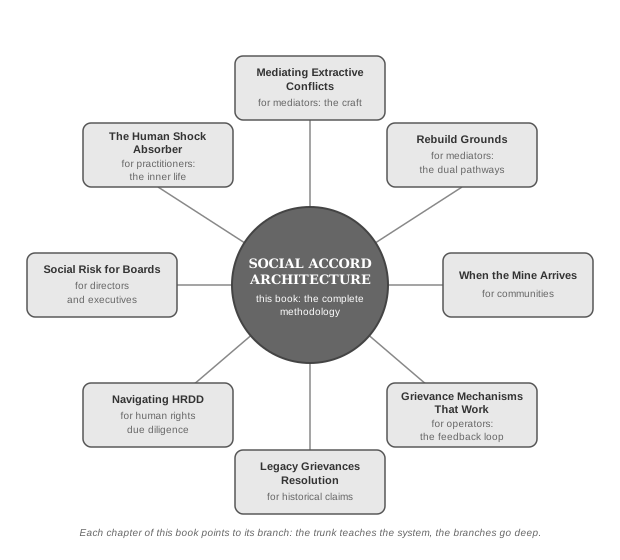
The books, the practice, the diagnostics and the training are not separate products that happen to share a name. They are the same method entered from wherever you happen to be standing.
The method only works if it is credible to everyone at the table. A process that favors one side loses the other, and a process that has lost one side is theater.
Protect the timeline, reduce social license risk, and meet due diligence obligations with operational substance rather than documentation.
Years of field experience, often with no formal credential, no structured method, and no professional community that recognizes how hard the work is.
People who have been through too many consultations that changed nothing, and need a process where their voice carries weight and the accountability is visible.
Regulators, lenders and development institutions who have to judge whether an engagement design will hold, from the outside, before the money moves.
The rest of the family
Short self-assessments that score a grievance mechanism, a due diligence process, or a community’s readiness to negotiate.
Run a diagnosticA serious game where company and community tables run the same contested project in parallel, then compare what their choices cost. The debrief maps the divergence back onto this method.
How the game worksThe practitioner side of the discipline, taught as practice rather than slides, with a certification program in production.
TrainingIn development: putting a defensible number on what social conflict is costing a specific project.
Join the launch listA design discipline for the relationship between an industrial project and the communities it affects. It treats that relationship as infrastructure: something that bears load, decays without maintenance, and can be deliberately built. It runs on five principles and four phases across the full project lifecycle, from pre-feasibility to closure, and it carries two mediation pathways for the disputes that arrive anyway.
No, and this is the most common misreading. GROUNDS and REBUILD are the two mediation pathways used when prevention did not hold. They are one component of the architecture, the contingency, and they are the subject of Rebuild Grounds. The discipline itself is larger: it is mostly about the work that happens before any dispute needs mediating.
Across ten published books. The cornerstone volume, Social Accord Architecture, is the complete statement of the method in one book. The others each write the discipline for a different side of the table: the practitioner handbook, the survival guide for the people in the middle, the community negotiation guide, the mediation methodology, the board handbook, the human rights due diligence guide, the field companion of one hundred practices, the grievance mechanism handbook, and the guide to legacy and historical claims.
Engagement is one element inside the architecture rather than the architecture, and a project can be rich in engagement and bankrupt in design. CSR fails a structural test rather than a moral one: it reports to executive authority, and a community cannot be asked to trust a process that answers to one party. The discipline is defined as much by what it refuses as by what it does.
Practitioners run the phases. Community relations and social performance teams use them to structure engagement inside an operation. Communities and their advisors use them to hold a process to a standard and to prepare their own side. Boards use the reporting layer to see social risk before it reaches the share price. Lenders and regulators use it to judge whether an engagement design is real.
Yes, and it goes past them. The frameworks map to the IFC Performance Standards, the UN Guiding Principles and FPIC requirements, and they produce the operational evidence the CSDDD and comparable regimes increasingly ask for. Compliance is where the discipline starts, not where it stops.
Tell me what is happening on the ground. Thirty minutes is usually enough for me to say which phase you are actually in, whether mediation is the right instrument at all, and what the first move should be.
Every first conversation is confidential.