Thomas Gaultier
Menu

A serious game

The Accord Game

A business game in the sense a business school means it, built for what happens between a project and the people living next to it. Two tables, one world: half the room runs a contested lithium project as the operating company, the other half lives beside it as the affected communities. Both face the same five crises, neither can see the other’s reasoning, and every decision has to be lived with.

Play it solo at theaccordgame.com, or run it for a cohort, a conference or a company. Up to 56 players, and anything from six hours to a six-week module.

What it is for

Power asymmetry is easy to describe and hard to feel

You can tell a room that one side of a company-community negotiation holds the money, the information and the clock. Nobody disagrees, and nothing changes on Monday.

A serious game does something a slide cannot. It hands you the weaker chair, or the stronger one, gives you a real budget and a real deadline, and then runs a crisis at you. You make a defensible decision. Two rounds later you meet its consequence, and it is not the consequence you expected. That is the entire teaching mechanism, and it is why business schools have used the format for decades on strategy and operations while almost nobody has built one for this.

What players take away is not a framework they memorised. It is the memory of having made the reasonable choice and watched it cost them.

What a player learns by doing

  • How a decision that is correct on its own terms becomes the reason there are no good options left three rounds later.
  • What it costs to hold a position when the other side can simply wait you out, and what it costs when you cannot.
  • Why the same commitment reads as partnership at one level of trust and as manipulation at another.
  • How a crisis rewards preparation nobody could see the point of at the time.
  • What the other chair was actually thinking, revealed only at the debrief.

The shape of it

Parallel worlds, running the same crisis

The room splits into three or four parallel worlds. Each world pairs one community table with one company table, five to seven players each. The paired tables share a single game state: one trust index, one grievance backlog, one river. They do not sit together and they do not negotiate face to face in ordinary rounds.

That is the design, not a limitation. They experience each other the way real counterparts mostly do, through observed actions and their consequences, and they find out what the other side was thinking only at the debrief.

The scenario is the Kavelo Lithium Project in the Republic of Malunda, a fictional composite built from projects I have worked on. Meridian Lithium plc, London-listed, three years into production on an 850 million dollar NPV. On the other side of the fence line, the Nkosi Valley: about 6,000 people across three villages, living from maize, cattle and the Luvane River.

Every event in it has happened somewhere, more than once. None of them at any single identifiable project, which is what lets everyone in the room play honestly.

Practicalities

Numbers
Up to 56 players in a single game: four worlds, two tables to a world, seven characters to a table. It scales down cleanly to one world, and all the way down to one person.
Time
Anything from six hours to six weeks. Each round is configurable from 30 minutes to a full week, so the same game runs as a single intensive day or as a term-long module.
Roles
Seven characters per table, written with equal depth on both sides: traditional leader, youth representative and women’s association chair on one, general manager, finance director and security manager on the other.
Kit
A purpose-built platform that runs a full session from one laptop with no internet. A tablet per table, a projector for the wall, and players use their own phones for the private reflection questions after each round.
Languages
English, French, Portuguese and Spanish.

Five rounds, roughly two years

Every world faces the same five events. Only the decisions differ.

Between rounds, months pass on screen. Each table gets its own interlude: what its choices produced, the months narrated back with its own decisions in them, the board moving, and a cliffhanger the next round makes good on.

A round can be set to anything from 30 minutes to a full week. Compressed, the five rounds are one intensive day. Stretched, they are a five or six-week module where a cohort lives with each decision before meeting its consequence, which is much closer to how this actually feels in the field.

The Announcement

Meridian confirms a 240 million dollar expansion. Survey teams start marking parcels within the week, the radio reports thousands of jobs though no official figure exists, and the visit notices arrive in English only. Expectations open faster than facts.

The Crash

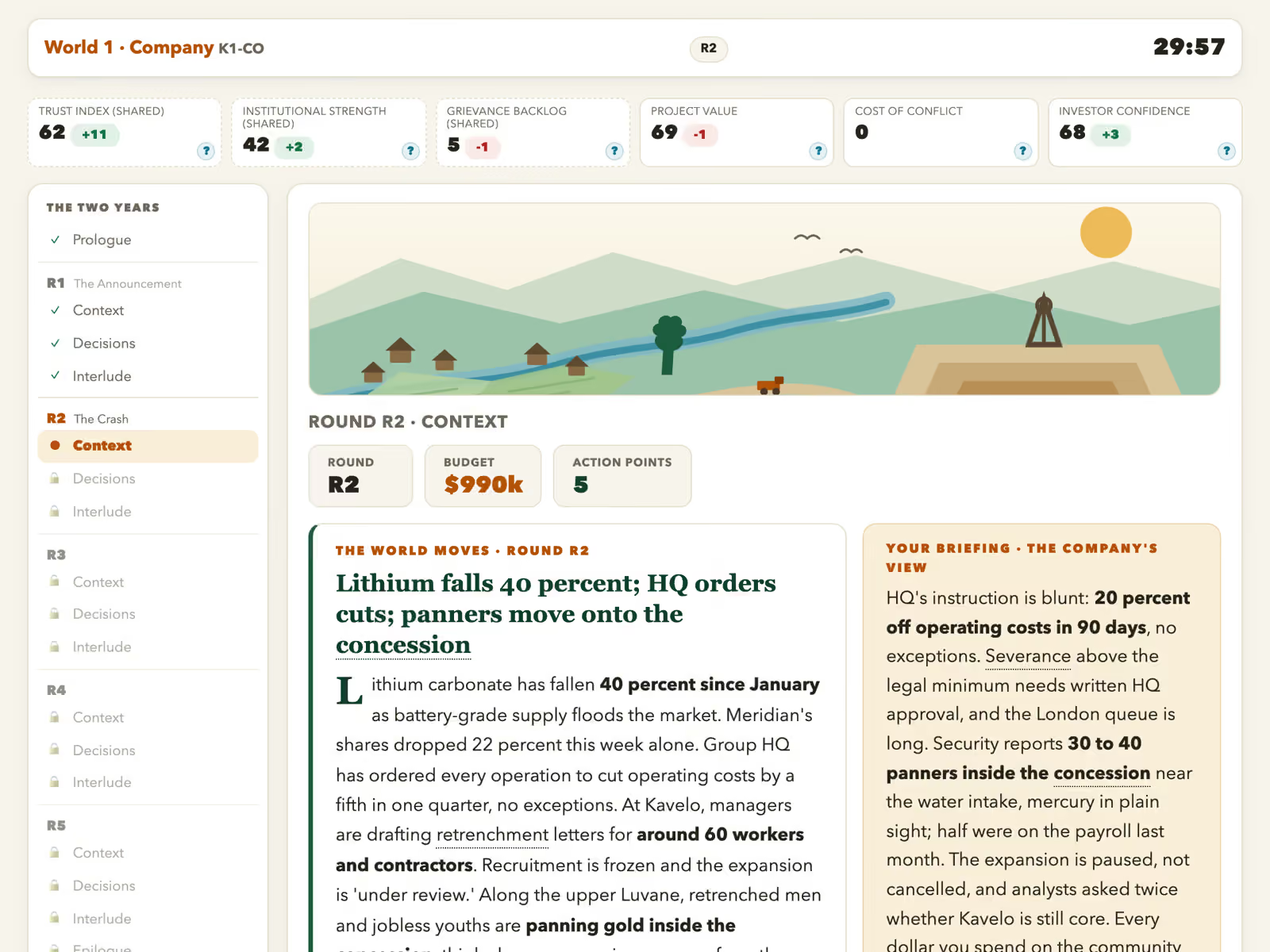
Lithium falls 40 percent and London orders a fifth off operating costs within the quarter. Around 60 workers face retrenchment, and retrenched men drift into artisanal gold panning on the concession. Both tables have to decide what the panners are: an enforcement problem, or a livelihood question.

The Spill

A storm drops 140 millimetres in six hours and the return-water dam overtops. Dead fish downstream, eleven children with stomach complaints, and a national paper asking "Poison in the Luvane?". No water results exist yet on either side. In worlds that never commissioned a baseline study, the environmental dial has read UNKNOWN since round one, and it still does.

The Handover

A private consortium buys 60 percent, subject to ministerial approval. Every budget line above 50,000 dollars goes under review, and the one manager who kept a written register of promises resigns. Do the old owner’s promises bind the new one? Nobody has answered that in writing.

The Reckoning

About 200 residents close the access road with tree trunks and production halts. The new owner gives 30 days. The ministry opens a formal review of the licence transfer. One window is open for an accord all three sides could defend, and it will not stay open long.

What makes it bite

The constraints are the teaching, not the scenario

Anyone can write a mining scenario. What people remember is discovering that the reasonable-looking choice they made in round one is the reason round four has no good options left.

Twelve options, five points, never everything

Each table gets twelve decisions written for its own chair, priced as a pyramid: three big moves, three workhorses, six quick ones. Five action points a round carry at most one big move plus very little else. A company cannot promise transparency at a podium and buy silence behind it in the same round, because the exclusion groups forbid it.

Things land late, or never visibly at all

A baseline water study commissioned in round one settles the facts war when the spill arrives in round three. The same study commissioned in round three reports after the game has ended. And the relational consequences do not sit in any pipeline: a quiet deal signed in the announcement season surfaces at a funeral a year later.

Trust is a rate, not a mood

It builds one to three points at a time and breaks in drops of five to fifteen, then it gates what your cooperation is even worth. A retraining fund announced at trust 65 reads as partnership. The identical fund at trust 35 reads as manipulation, and pays accordingly.

You see the other table act, not explain

Every locked decision emits one line to the counterpart. The company locks "harden security" and the community reads "Arrests at the river: two Mbara youths held overnight." Sixteen combinations produce effects beyond the sum of the two choices. A march into fresh patrols becomes a confrontation both tables own.

Mediation is a mechanic with a payoff

Every round, both menus carry a low-cost option to propose or accept a facilitated dialogue table. If both sides choose it in the same round, the bonus lands and each table nominates delegates to a standing table for five minutes, one rule: no speeches, ask questions. An outstretched hand that goes unmatched costs you standing, because in the field it does.

Four ways the world changes shape

Lose the investors and the lenders pull the project into care and maintenance. Splinter the valley and the state fast-tracks the licence over its head. Build cohesion and leverage and the community wins a consent regime where nothing advances without its documented yes. No single mistake trips any of them. Only compounding chains do.

The debrief

Where the morning becomes an argument

Each table reveals its own ending first, on its own screen, before anything goes on the projector. Then the comparison: trust curves for each world laid over how each world believed its trust was doing, decision timelines, the cost of conflict accumulating against their own choices, and hidden consequences traced back to the decision that seeded them.

The part that lands hardest is the counterfactual re-runs, showing what one different choice would have changed. Three or four worlds played identical events and got different endings. We map that divergence onto Social Accord Architecture, and the framework stops being a diagram.

Why a mixed room is best

Put a general manager, a community relations officer, a lawyer and someone from sustainability in the same world and the arguments they have in the game are the arguments they have been avoiding at work.

It also runs well with community representatives playing as full participants and executives playing community roles opposite them. A morning spent as a farmers’ representative teaches something no panel can.

Ways to play

One game, four rooms

The same economy and the same five crises, sized to who is playing.

On your own

Solo

One player against the model, online, in your own time. The fastest way to find out whether the format is worth a morning of your organisation’s time.

Teaching

University and executive cohorts

Six hours in one block, or one round a week across a five to six week module. Run slowly, a cohort has days to research, argue and second- guess between rounds, and the consequences land on people who have had time to grow attached to their decisions.

In public

Conferences

A programme session where delegates negotiate instead of watching a panel discuss communities. Synchronised results produce the moment a conference is remembered for: fifty people going quiet at once, then arguing across tables.

Inside the business

Companies

Leadership offsites, social performance functions, and the mixed rooms where operations, legal and sustainability rarely have to reach one decision together. Useful before a real negotiation, and after a bad one.

A different game

Standing in the Middle

If what you want is one person, one evening and no facilitator, that is the other game, and it is not a smaller version of this one.

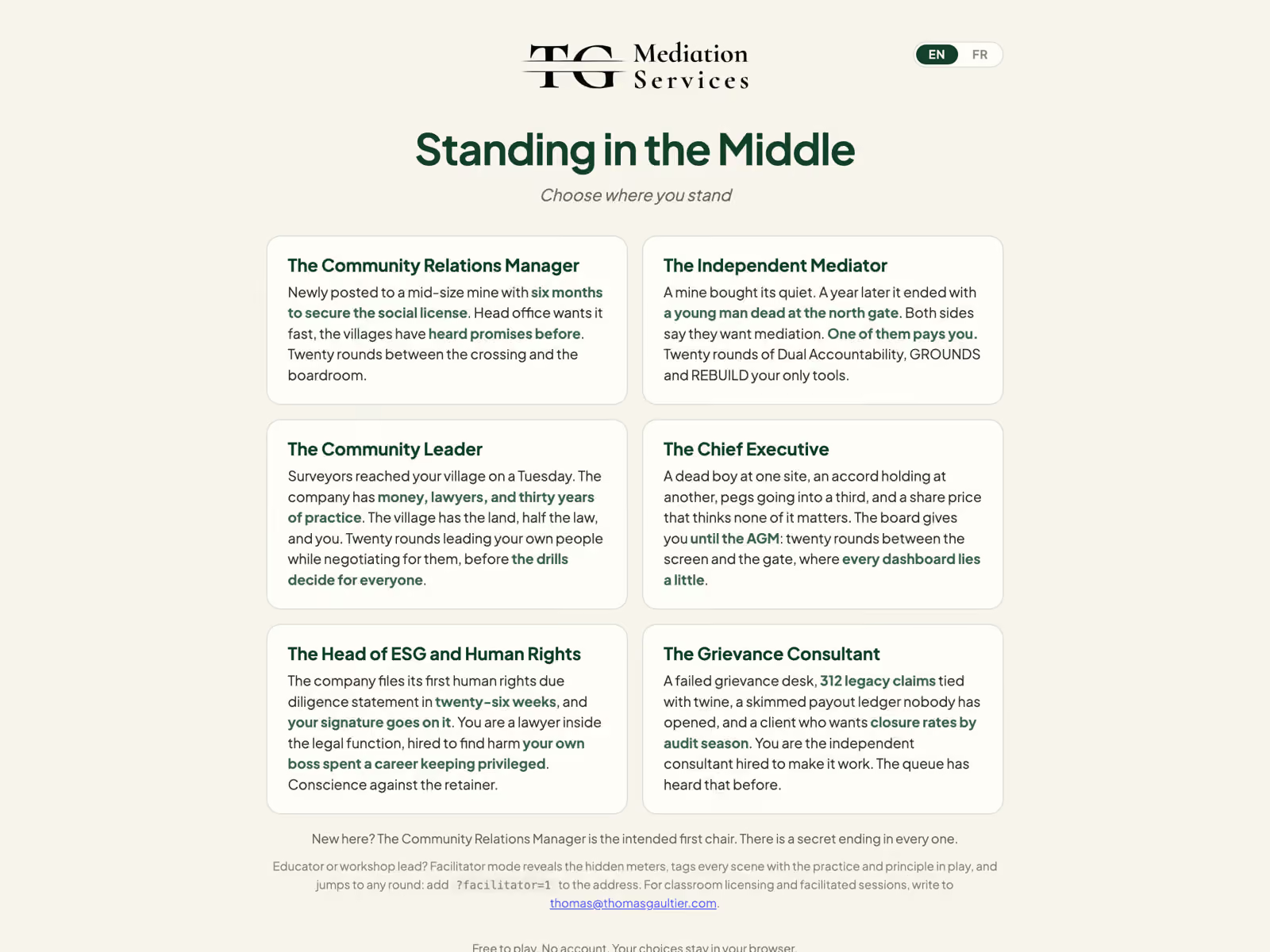
Standing in the Middle is a single-player narrative game with its own project and its own cast: the community relations manager, the mediator, the community leader, the chief executive, the ESG lawyer and the grievance consultant, all in one shared world. You pick a chair and live with what you decide from it. Free, about forty minutes, in English and French.

Which one do you want

A room to argue
The Accord Game. Up to 56 players, six hours to six weeks, facilitated.
One person to understand
Standing in the Middle. Free, solo, forty minutes.
Both
Send the solo game round as a pre-read, then run the facilitated session. People arrive already knowing that the other chair has reasons.

Want to run this with your room?

Tell me who will be in it, how long you have and what you want them arguing about afterwards. I facilitate the session with trained co-facilitators, one per world, or I can train someone on your side to run it. The platform is built and has been verified end to end, so the lead time is about the room rather than the software.

Every first conversation is confidential.