
About Thomas Gaultier
Specialist community mediator for mining, oil and gas, and energy projects
Fifteen years resolving extractive industry disputes across Sub-Saharan Africa, Europe and Asia. More than 2,000 community and historic claims mediated. Former community and social performance officer for a European junior miner, and now advisor and trainer to companies, communities, government agencies and civil society.
Trusted by and affiliated with



From crisis management to structured process
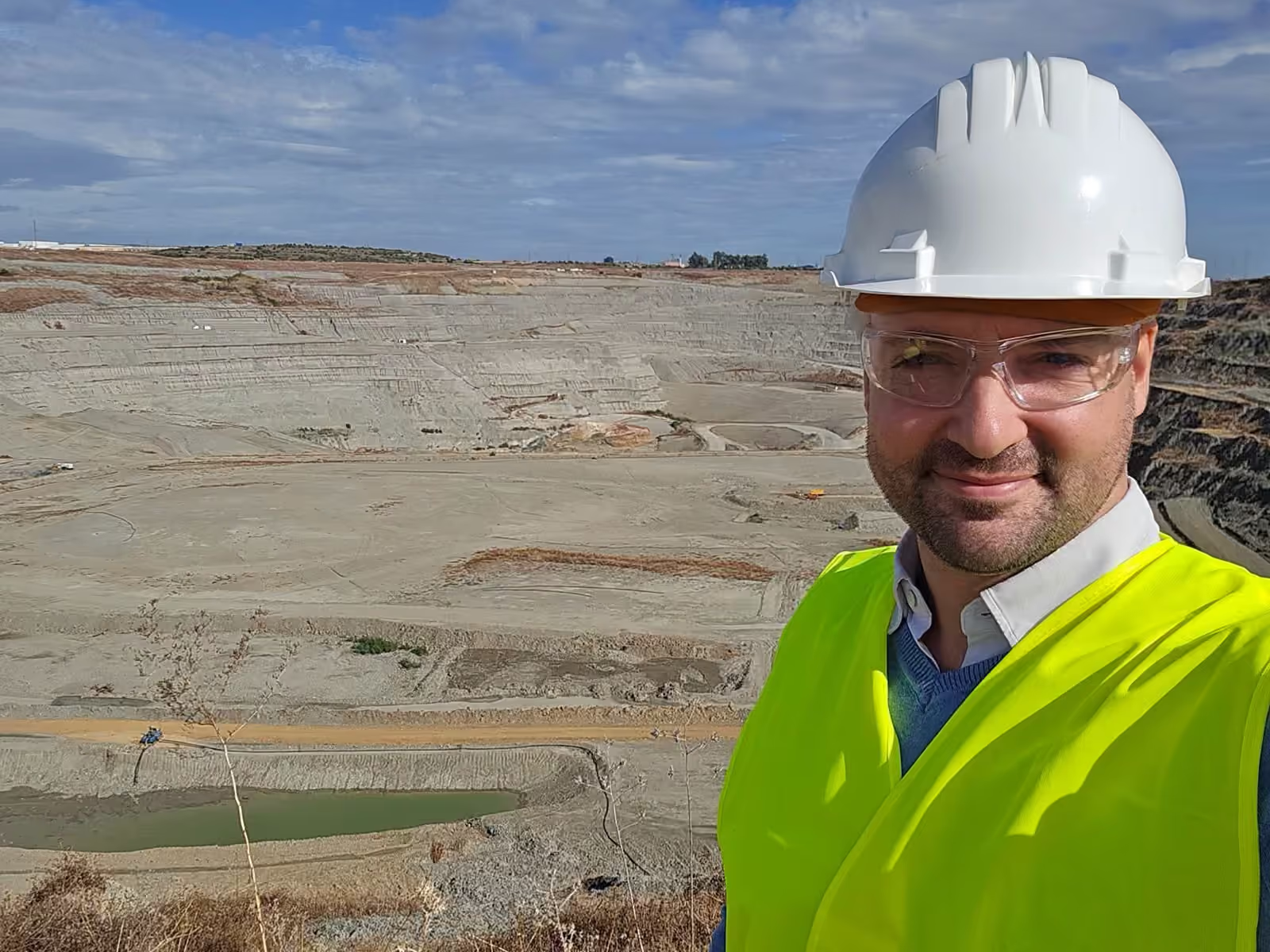
Built in the field, not in a classroom
I have spent fifteen years proving one thing: that conflict between an industrial project and the people living beside it can be resolved through a process, rather than managed as a series of crises by whoever happens to be brave enough.
After mediating more than two thousand community claims in Mozambique, I wrote down what worked. That became Social Accord Architecture: a field-tested method that gives a company and a community the same framework and the same vocabulary for the conversation they are about to have.
I currently serve as mediation expert across the mining projects of the Gemfields Group and work as an international legal and dispute resolution consultant in the energy sector. My mandates have taken me to Mozambique, Zambia, the Republic of the Congo, Turkey, Tunisia, Thailand, France, Portugal and the United States, in contexts where the relationship between the operator and the surrounding communities was the variable that decided whether the project moved at all.
Credentials
- Admitted to the New York Bar
- LL.M. in Alternative Dispute Resolution, University of Texas at Austin
- MBA in Mining and Raw Materials, Escuela de Organización Industrial, Seville
- Co-founder and Vice-President, ICFML
- Lecturer in negotiation, mediation and common law, Universidade Católica Portuguesa
- Law professor, Forward College, Lisbon
Working in English, French, Portuguese and Spanish.
The numbers behind the work
Where livelihoods and investments find common ground
- 15+
- years in extractive sector mediation
- 2,000+
- multi-party claims mediated
- 10+
- countries with project experience
- 500+
- industry professionals trained
One party arrived by helicopter. The other walked three hours.
Why this work needs a specialist
I have sat in mediation sessions where one party arrived by private helicopter and the other walked three hours from their village. That is the reality of extractive industry conflict, and no amount of process design makes it go away.
I have facilitated dialogues where sophisticated legal and technical teams negotiated across a table from elders who never attended formal school. I have worked on projects where hundreds of millions of dollars sat on one side of the ledger and questions of cultural survival on the other.
These power imbalances are real. They shape every part of the conflict, and a process that pretends otherwise is theater.
What drives me
To prove that industrial projects and the communities they affect can build something lasting together, by replacing conflict with structured dialogue that protects both livelihoods and investments.
What the work makes possible
- Communities secure benefit agreements and environmental protections that carry monitoring.
- Companies gain the social license a project needs to actually operate.
- Conflicts that would have reached the road or the courts reach a negotiated end.
- The relationship built during mediation becomes the mechanism for the next dispute.
The honest version
This work is hard, and I would rather say so than sell it. Extractive projects generate legitimate conflict. Environmental impacts are real. Economic dependency creates vulnerability. Historical grievance runs deep and does not dissolve because someone drew a process diagram.
Mediation does not erase any of that. What it can do is create conditions where people negotiate on interests instead of positions, where technical complexity gets translated rather than weaponized, and where the power imbalance is named and handled instead of politely ignored.
After fifteen years I am more convinced than I was at the start that this sector needs specialists. The projects are not stopping. The world wants the minerals and the energy more than ever. The only open question is whether the extraction happens through conflict or through a negotiated process that respects both community rights and operational reality.
Conflict is inevitable. Bad process is not. That distinction is what I have spent my career on.
In the press
On the Barroso lithium project
The Mining Journal followed the fight over Europe’s largest lithium deposit in northern Portugal, where I ran community relations for the operator.
The emotional attachment that the population has to the land is a huge issue. Having a mine nearby, from their perspective, is an invasion of space, an intrusion. The danger is that if you feel someone is invading your space, you might feel you have very little control over what is going on.
Richard Wachman, Mining Journal, March 2024. Read the article
Thomas demonstrates an incredible capacity of active listening and always finds new topics to learn and share; he has a continuous curiosity about the world and a true commitment and care for people that work with him.
Thomas is a multi-skilled, energetic and well qualified Dispute Resolution practitioner who is dedicated to building the commitment of Portuguese lawyers to non-adjudicative Dispute Resolution. He is a pioneer in his field and a privilege to work with.
Conflicts do not wait for budget cycles or board approval.
If you are dealing with community conflict on a mining, oil and gas, or energy project, thirty minutes will tell us both whether I can help. Active opposition, an FPIC process, a resettlement plan, or a dispute that has not surfaced yet. No obligation, no generalist pitch.
Every first conversation is confidential.