
Thomas Gaultier
Menu

Community mediation

When the relationship between your project and the communities around it has to be built, repaired or held

I work as an independent mediator, facilitating structured dialogue between extractive companies and affected communities at the moments that decide whether a project continues.

What the mandate includes

Mediation is not getting people in a room together

The room is the easy part. What makes an agreement durable is everything around it: the preparation, the design, the reality-testing, and the months after signature when the agreement either becomes practice or becomes paper.

Pre-mediation assessment

Confidential interviews with every party to map the history, the current concerns, the power dynamics, the cultural ground and the issues actually at stake. This is where I find the interests underneath the positions, and the obstacles nobody has named yet.

Process design and ground rules

Parties agree how the mediation will run before anything substantive is discussed: ground rules, communication protocols, confidentiality boundaries, session structure. Procedural fairness first, because without it nothing said later is believed.

Facilitated sessions

Joint meetings, private caucuses and shuttle diplomacy as the situation requires. I keep participation balanced, help people articulate what they actually need, reality-test proposals, and hold the process when it gets difficult.

Technical expert coordination

When the dispute turns on impact assessments, closure plans, water management or an FPIC process, I bring in subject matter experts so both sides work from credible information. It avoids the duelling-experts spiral without compromising my neutrality.

Agreement drafting support

Turning understandings into written commitments that can be implemented: precise obligations, monitoring mechanisms, a procedure for future disagreements, and a realistic view of what each side can actually deliver.

Implementation support

Mediation does not end at signature. I facilitate the first implementation meetings, stay available for interpretation questions, run check-ins at 30, 60 and 90 days, and come back quickly if something breaks.

G R O U N D S Phase 0 Groundwork Phase 1 Rapport Phase 2 Organise Phase 3 Understand Phase 4 Navigate Phase 5 Deliberate Phase 6 Secure G: Have we laid the foundation for productive engagement? R: Have we established conditions for honest dialogue? O: Have we built a shared agenda addressing everyone's concerns? U: Have we uncovered what truly matters to each party? N: Have we generated enough options for creative solutions? D: Have parties deliberated thoroughly to reach decisions? S: Have we secured an agreement that will hold?
GROUNDS end to end. Each phase closes on a question that has to be answered before the process may advance. Rebuild Grounds, Figure 4

Seven phases, and a gate on each one

The mandate follows a defined arc rather than a mediator’s instinct. Each phase closes on a question that has to be answered before the process is allowed to move, which is what stops a mediation arriving at bargaining before anyone has understood what is actually at stake.

Where serious harm sits in the room, the process changes rather than slows: a second, trauma-informed pathway puts safety, truth-telling and acknowledgment ahead of any negotiation.

Who this is for

Everyone at the table benefits from a process that respects both operational reality and legitimate grievance

why does that matter? why does that matter? why does that matter? why does that matter? THE POSITION No mining within 10 kilometers of our water source INTEREST Protection of water quality INTEREST Health security for community members INTEREST Trust that promises of protection will be kept INTEREST Control over decisions affecting their lives OPENS: technical solutions and monitoring OPENS: health measures and baseline studies OPENS: verification mechanisms and community oversight OPENS: participatory decision-making structures The layer at which questioning stops determines the solutions that can be seen.
Underneath a stated position sit layers of interest. Most processes never reach the bottom one. Rebuild Grounds, Figure 7

Nobody at the table is asking for what they need

A community demands a number. A company refuses a precedent. Both are positions, and both are the top layer of something else: a substantive need, a procedural one about being taken seriously, and a psychological one about being treated as though the last ten years happened.

Most failed mediations in this sector fail because they bargained the top layer. The work is getting to the bottom one without anyone feeling exposed for having gone there first.

Mining, oil and gas, and infrastructure companies

Community opposition is threatening permits, financing or operations. Previous engagement has not resolved it. Litigation, regulatory intervention or delay is now on the table.

You need a mediator when the conflict has moved beyond what your community relations team can resolve internally.

  • Hear community concerns directly rather than filtered through third parties
  • Demonstrate genuine engagement to regulators and lenders
  • Resolve faster and cheaper than litigation
  • Protect the social licence you still have
  • Leave behind a monitoring and dispute mechanism for the relationship

Communities and residents

You live with the project. You have real concerns about environment, health, heritage, land or promises that were not kept. The consultation feels like a performance.

You need a mediator when direct communication with the company is producing nothing, or does not feel safe.

  • Be heard by the people who actually decide, in a structured setting
  • Get the information you need to make an informed decision
  • Have technical complexity translated rather than used against you
  • Negotiate from dignity rather than from powerlessness
  • Reach agreements that carry monitoring and can be enforced

Indigenous peoples and traditional authorities

A project on or near your territory threatens cultural sites, land, water or livelihoods. You hold consultation and, in many jurisdictions, consent rights that the operator is treating as a checkbox.

You need a mediator when an FPIC process breaks down, or when consultation requirements are being observed in form only.

  • Assert rights inside a negotiation framework that respects them
  • Bridge the cultural and communication distance
  • Ensure traditional knowledge shapes the decision
  • Negotiate benefit sharing and mitigation that reflect your values
  • Set consent and consultation protocols for the life of the project

Permitting and regulatory authorities

You oversee permitting, consultation or dispute resolution, and a project is stalled by a conflict that threatens development, community wellbeing or your own legitimacy.

You need a mediator when hearings and compliance orders are not producing a resolution.

  • Facilitate resolution without having to impose one
  • Satisfy consultation requirements in substance
  • Reduce the regulatory burden of managing an ongoing dispute
  • Support agreements that do not collapse once permits are granted

Why the sector matters

This is structurally different from other mediation work

The power asymmetry between an operator and an affected community is not a complication in the process. It is the central dynamic the process exists to manage. Add a history of agreements that were not honoured, consultations that were form rather than substance, and frameworks like FPIC that carry real legal weight, and a generalist mediator is working without a map.

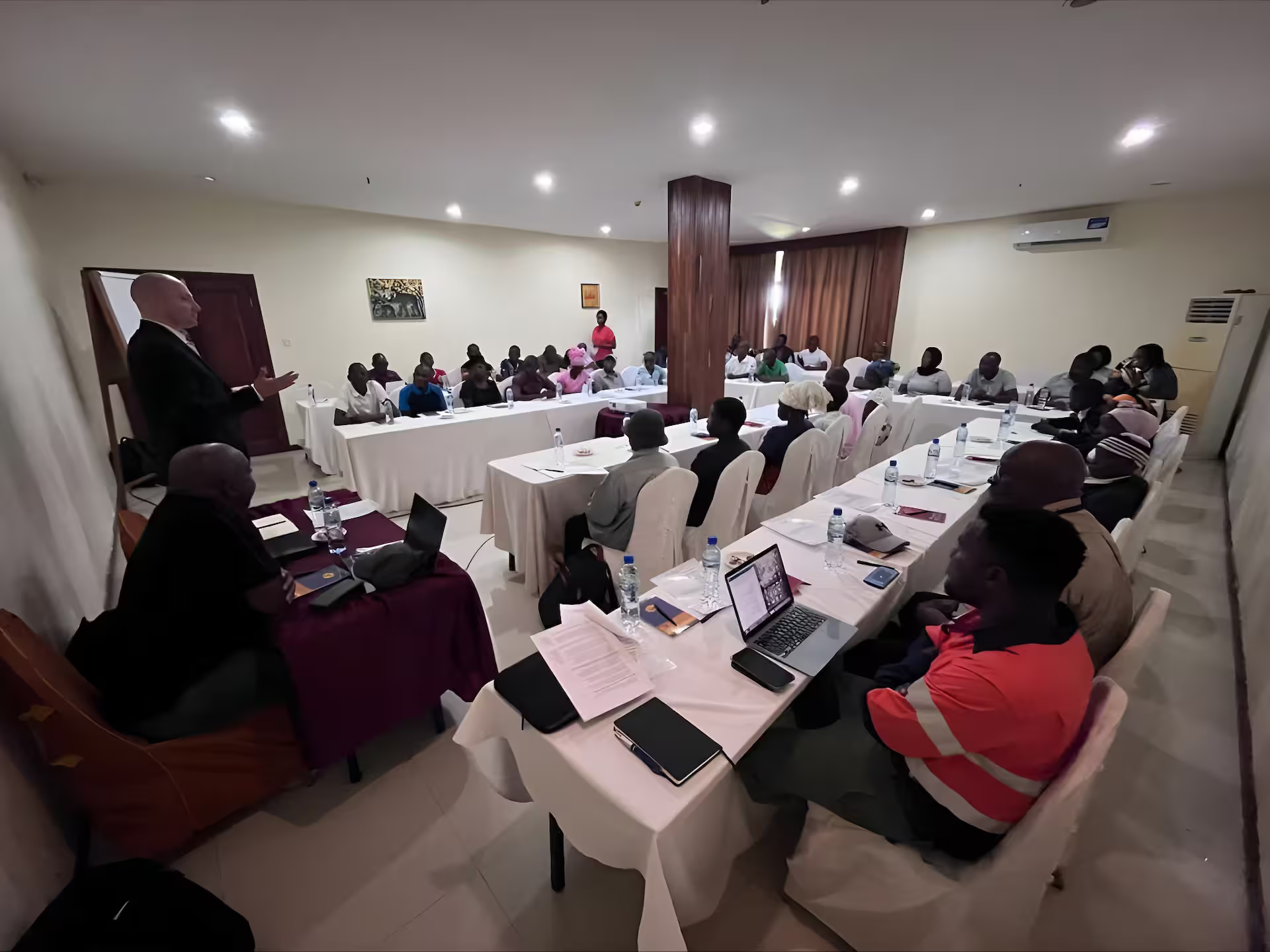
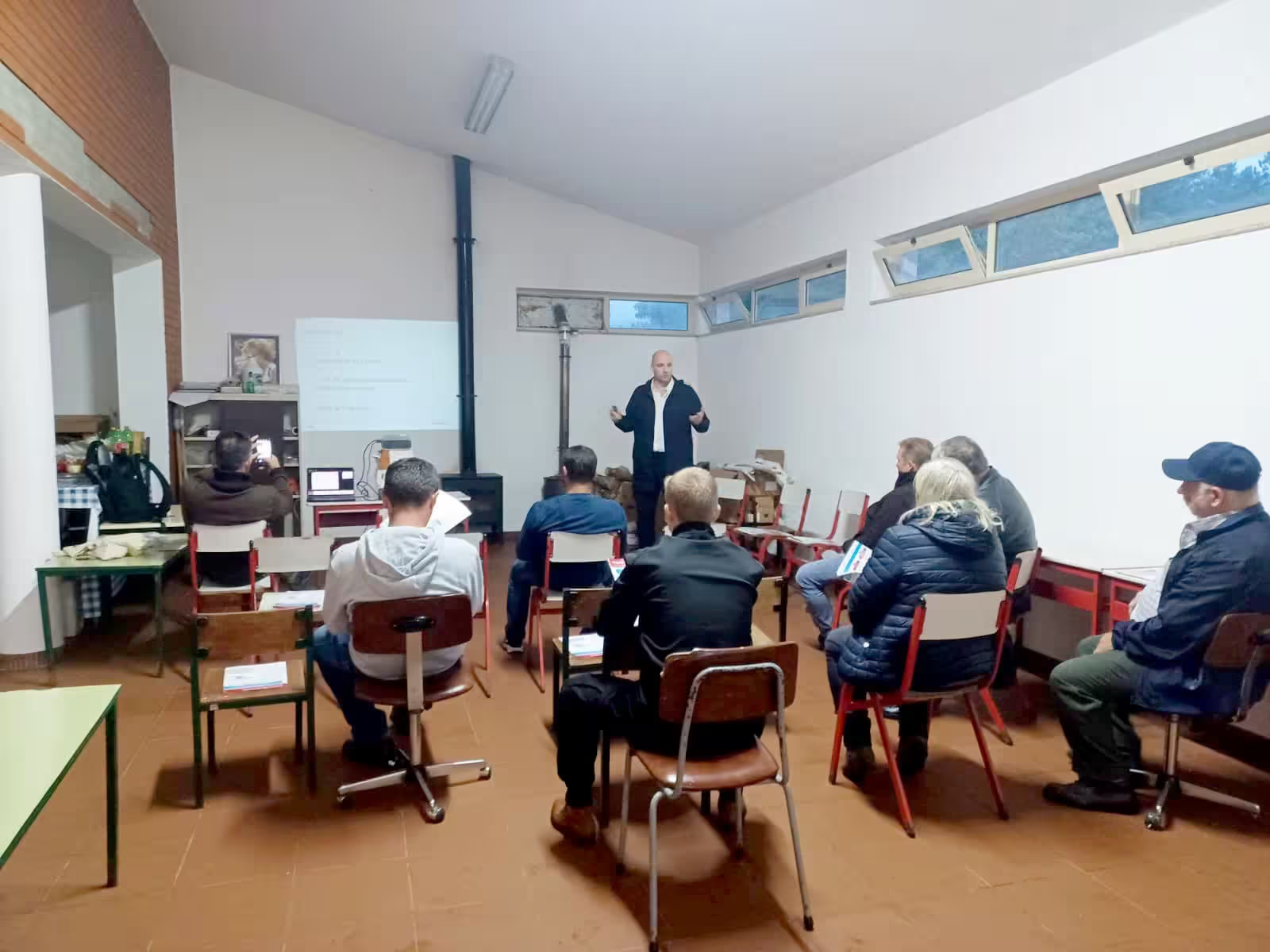
I have worked inside these dynamics in Mozambique, Zambia, the Republic of the Congo and Portugal. I know what operational pressure looks like from the company side because I have carried it, and I know what a community means when it says the last consultation changed nothing.

I hold the process rigorously and I bring no agenda on the outcome. My job is to create conditions where parties with good reason to distrust each other can reach an agreement they both intend to keep.

PROCEDURAL NEEDS Process fairness Voice and inclusion EMOTIONAL NEEDS Feelings validated Being heard SUBSTANTIVE NEEDS Tangible outcomes Concrete resolution DURABLE AGREEMENT
An agreement has to satisfy three things at once. Fail any one and the settlement does not hold. Mediating Extractive Conflicts, Figure 8

The emotional attachment that the population has to the land is a huge issue. Having a mine nearby, from their perspective, is an invasion of space, an intrusion. The danger is that if you feel someone is invading your space, you might feel you have very little control over what is going on.

Thomas GaultierMining Journal, March 2024

Where this shows up in print

The full method is in Rebuild Grounds, and the practitioner handbook is Mediating Extractive Conflicts.

Thomas played a crucial role in ensuring agreement was reached during discussions between MRM and community leaders and representatives. Since these discreet engagements, Thomas has been retained by Gemfields on an ongoing basis to provide mediation advice, support and training. Thomas has proven to be a skilled mediator and trainer.

Gemfields GroupMontepuez Ruby Mining, Mozambique

Practical questions

When is mediation appropriate, and when is it not?

Mediation works when all parties participate voluntarily, when the people at the table can make binding commitments, when power imbalances can be handled procedurally, when the interests are worth exploring, and when resolution genuinely beats continued conflict for everyone.

It is the wrong instrument when violence or intimidation makes safe participation impossible, when a party lacks the capacity or authority to negotiate, when the matter is criminal and belongs with law enforcement, when fundamental rights violations require a regulator or a court, or when one side sees clear advantage in staying adversarial and will not engage in good faith.

I assess this during the initial consultation, before recommending anything. Sometimes the honest answer is that you do not need me.

What does it cost?

It depends on complexity, expected duration and logistics. After the initial consultation I send a proposal with a fee structure: a fixed fee for simple and predictable mediations, daily or hourly rates for complex ones, a retainer for multi-session mandates.

Costs are usually shared between parties unless one side agrees to carry them. In every case I have worked on, mediation has cost a fraction of litigation, before counting the indirect cost of delay and reputational damage.

The initial consultation is free, so you can assess fit before committing to anything.

How long does it take?

A simple dispute runs 4 to 8 weeks from first contact to agreement. Moderate complexity is 2 to 4 months. A complex multi-party conflict takes 6 to 12 months, sometimes longer.

Even the long ones resolve faster than litigation, and the pace follows what the parties can sustain rather than a court calendar.

Do you take sides?

Not on outcome. I do not advocate for anyone’s position and I do not rule on who is right.

I am not neutral about process. I make sure everyone can participate meaningfully, I address the power imbalances that would otherwise make dialogue meaningless, I reality-test proposals against operational constraints, and I will not facilitate an agreement I believe a party cannot or will not implement.

Is it confidential?

Yes, within boundaries set out in the process agreement. Discussions cannot be used in later litigation, I cannot be called as a witness, and what is said in a private caucus stays there unless that party authorises disclosure. Final agreements are usually not confidential, because they are implemented in public.

Confidentiality has limits. It does not cover imminent harm, illegal activity, or matters the parties agree should be disclosed. Those limits are stated clearly before anything begins.

Can a mediated agreement be enforced?

Yes. A mediated agreement is a binding contract. A well-drafted one carries specific measurable commitments, implementation timelines, monitoring and reporting, a procedure for interpretation questions, a dispute process for future disagreements, and remedies for non-compliance.

Some parties register the agreement as a consent order with a court or regulator for extra enforcement. Most are honoured voluntarily, because the parties built them rather than having a settlement imposed.

What if we do not reach agreement?

Not every mediation ends in a full settlement, and that is a legitimate outcome. Parties usually leave understanding each other more accurately, some issues get resolved even when the whole does not, positions move, and everyone knows a serious collaborative attempt was made.

Nobody waives anything by participating. All legal and regulatory options remain exactly where they were.

If this sounds like what you are dealing with, let us talk.

Thirty minutes is enough for me to understand the situation and tell you honestly whether I am the right person for it. There is no obligation and no pitch.

Every first conversation is confidential.