

Most community agreements are built to be signed, not to last. The negotiating team pushes hard for months, the ceremony happens, the photographs are taken, and everyone moves on to the next deadline. Then, quietly, over the years that follow, the agreement hollows out. The manager who made the promises transfers to another asset. The elder who remembered why a particular clause exists dies. The budget line that funded the monitoring gets trimmed in a cost review, in the name of efficiency. Within five years, an agreement can be operated entirely by people who were not in the room when it was made, and who have no idea why half of it says what it says.
This is the durability problem, and a better contract does not solve it. Two linked design choices inside Thomas Gaultier’s Social Accord Architecture do. The first is the Resilience Handover, which makes the agreement outlast the individuals who built it. The second is Dual Accountability, which binds both sides to their commitments so neither can quietly walk away once attention moves elsewhere. One transfers the machine to the people who must run it; the other keeps both of them inside the machine after the founders are gone. In the SAA both belong to Phase 4, the stewardship work that decides whether everything built in the earlier phases survives contact with time.
Why agreements decay, and why that decay is predictable
Relational decay has mechanics, and once you can name them you can design against them. Three forces do most of the damage, and every practitioner who has stayed on a site long enough learns to expect all three.
People rotate. The company loses the champion who understood the community; the community loses the leader who trusted the company. Neither departure is dramatic, and both are fatal if nothing was built to survive them. Memory fades asymmetrically: companies forget their commitments faster than communities forget their injuries, a gradient reliable enough to plan around. Assume the community will remember the exact wording of a promise the company has already misfiled. Budgets erode. The agreement’s funding is nobody’s empire inside the company, so each fiscal year nibbles at it until the structure meant to sustain the relationship is a shell with a letterhead.
The governance research on community agreements reaches the same conclusion in its own vocabulary. Agreements that lack renewal provisions, responsibility-transfer clauses, and standing accountability mechanisms tend not to survive the project’s lifetime, and they are especially exposed when the asset changes hands. The World Resources Institute and the clean-energy governance literature both make the point directly: a durable agreement carries language for how it renews, amends, and transfers responsibility across a change of ownership or a move into closure. The agreements that hold do something the fragile ones skip. They institutionalize. They build a governing body that outlives any single officeholder, with the authority and the funding to keep the commitments alive after the founders scatter.
Social impact assessment worked this out before community agreements did, and the mechanism is worth borrowing intact. The tool it uses is a social impact monitoring plan, whose standard columns are the social impact, the desired outcome, the monitoring method, the responsibility, the timing or frequency, and the KPI. On its own that is a spreadsheet, and a spreadsheet is only as durable as the person who maintains it. What makes it hold is where it sits. Best practice places the monitoring plan inside a broader environmental and social management system, a live, adaptive-management process rather than a document that is filed and admired. That system carries its own budget, its own trained staff, its own grievance channel, and its own review cycle, and it is the same discipline the IFC Performance Standards require for projects carrying significant social risk.
That placement is the whole point of a handover. You are not transferring the accord to the elder who remembers it, or to the manager who believes in it. You are transferring it to a function that has a place in the org chart, a line in the budget, and a calendar that fires on its own. This is why durability is a design problem rather than a goodwill problem: good intentions decay on the same schedule as everything else on a mine site, and structure is what runs on a calendar instead of on someone remembering to care. The companion piece on measuring relationship quality through social performance indicators covers the monitoring instruments that keep a relationship honest year after year, and the handover is what makes sure someone local is still reading them a decade in.
Dual Accountability: why the load-bearing idea is two-way, not one-way
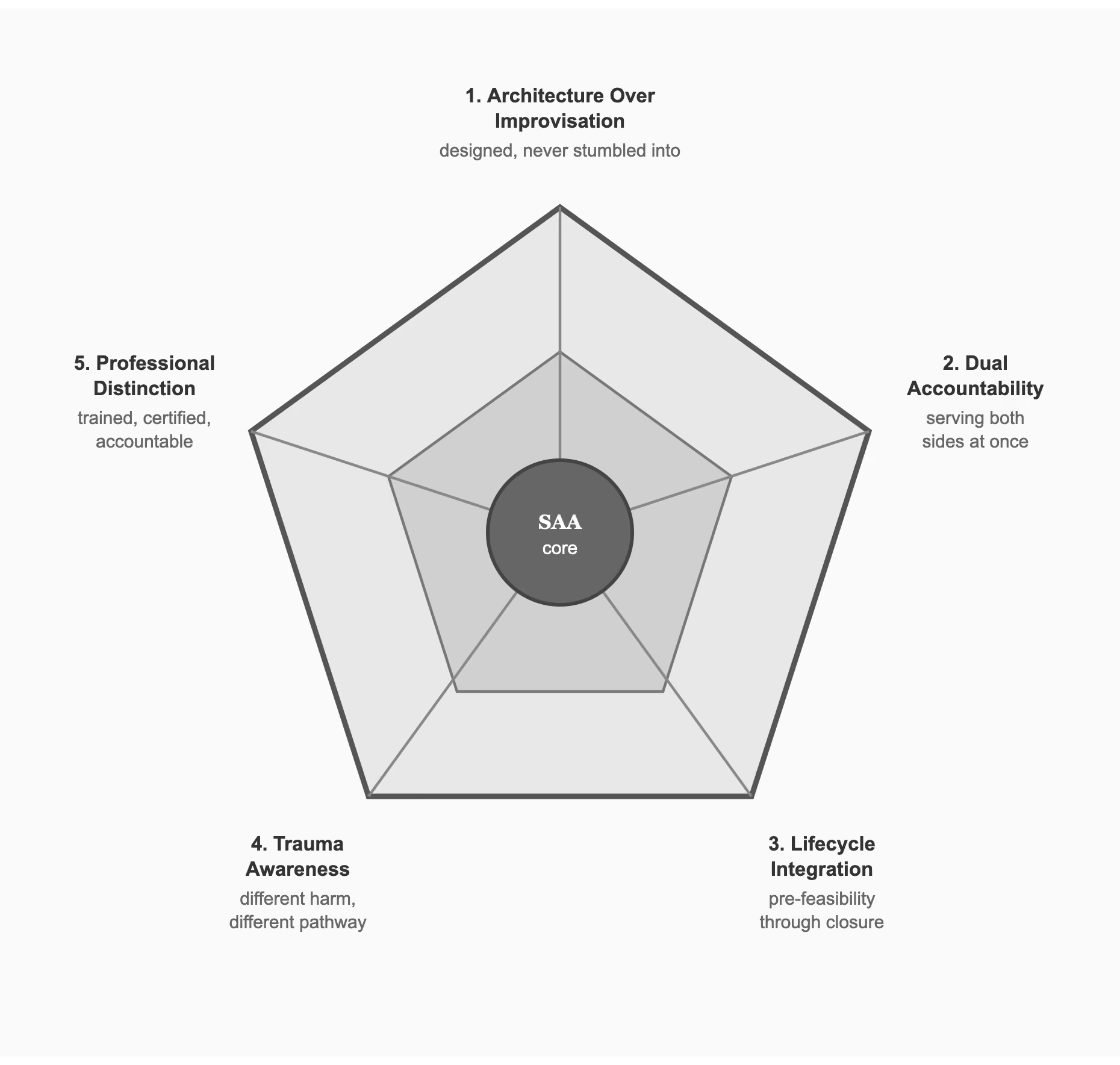
A handover transfers the machine. Dual Accountability is what keeps both parties inside it, and it is the second of the five principles that hold the SAA together. In the framework’s own words, the methodology serves both communities and projects simultaneously, and the moment it appears to favor one side, it loses the trust of the other. That is easy to nod at and easy to misread. It does not mean splitting the difference, and it does not mean having no values. It means the process itself answers to both sides at once. The community can verify that the architecture protects them, the company can verify the same, and neither could quietly capture it if they tried.
The reason this is the load-bearing idea, and not a nicety, sits underneath the principle. Protecting a community and protecting an investment are not opposing goals. They are the same goal pursued through two different lenses, and the accountability has to run in both directions because a one-directional version fails predictably. An agreement that binds only the company invites the community to enforce it the only way a one-sided deal can be enforced, through protest, which is the adversarial default structured agreements exist to replace. An agreement that binds only the community is not an agreement at all. It is a permit dressed as a partnership, and communities read the costume immediately. Two-way accountability is the only arrangement from which both sides will hand you the truth, and the truth is the raw material the whole process runs on.
The exact wording of the principle carries the method: visible neutrality. Neutrality that lives only in a practitioner’s heart is worthless, because nobody can inspect a heart. Visibility has to be engineered through mechanics that both sides can watch. Five of them do the work.
Access is symmetric. Every briefing offered to one side is offered to the other. There is no side meeting the community does not know happened, and no community caucus the company is briefed on afterward. The instant one party starts receiving information the other cannot, the neutrality is gone whether or not anyone intended it, because both sides now have to wonder what was said in the room they were not in.
Reports are delivered to both parties in the same form on the same day. Not a version for the company on Monday and a softened summary for the community on Friday. The same document, the same numbers, the same findings, released simultaneously. Sequenced disclosure is capture in slow motion: whoever reads first gets to shape how the other reads, and the party that always reads second learns exactly where it stands in the arrangement.
Process decisions are taken in the open, co-chaired, and minuted. The decisions about how the process itself runs, the agenda, the sequence, who is heard and when, are not the facilitator’s private prerogative. They are made by a body chaired jointly, and they are written down. Minutes are not bureaucracy here. They are the receipt that lets either side check, months later, that a decision was taken the way it was described.
Funding arrangements are disclosed. The first question any community asks a facilitator is who pays you, and that deserves a structural answer rather than a sincere one. Where the company pays, as it usually does, the architecture has to show the community what the money cannot buy. That is where the sharpest line in the principle lives: no veto over findings, no preview of reports, no quiet channel. The company that funds the process cannot see a report before the community does, cannot strike a finding it dislikes, and holds no back channel the community is not party to. Disclosed funding without those three prohibitions discloses a problem rather than solving it. The prohibitions are what turn “the company pays” from a fatal fact into a manageable one.
What one-sided practice breaks is not abstract. I watched a gifted colleague cross the line over two hard years on a single site. He moved, gradually and with the best intentions, from serving the process to championing the community inside it. He shaded his reports. He coached one side’s strategy. He was certain his cause was just, and it probably was. It also ended his usefulness. The company stopped telling him the truth first, then stopped inviting him. Deprived of his access, the community lost the one channel that had ever moved their issues, and his successor inherited a process both sides now assumed was rigged, merely in opposite directions. He had not failed morally. He had failed structurally. By becoming one side’s asset, he destroyed the only thing that made him valuable to either. That is the mechanism Dual Accountability is built to prevent, and it is why the discomfort of the exact middle is not a bug in the position. It is the fee for holding it. A practitioner in that middle will be accused from both directions, and the accusations are not a malfunction. They are the load-bearing test that the position is real.
The Resilience Handover: designing yourself out of the job
The most dangerous person on a mature agreement is its indispensable facilitator. Whatever good that person does day to day, their indispensability is the single largest unmanaged risk in the whole arrangement, a single point of failure walking around on two legs. The principle behind the Resilience Handover, Instrument 4.2 in the SAA framework, states it without softening: a process that depends on external facilitators indefinitely has not built infrastructure. It has built dependency.
The Resilience Handover is the structured transfer of an accord’s governance to local stakeholders, without dependency. Its explicit goal is the practitioner’s own obsolescence, and that goal should be written into the contract from the first day rather than discovered at the end. This is the phase a practitioner’s ego likes least, because it is designed to end the practitioner’s own role, and the phase that decides whether anything they built survives them. Handover is not an event. It is a staircase climbed over years, and each step is earned by a readiness test, never granted by a date on a calendar. Naming the five steps turns a vague aspiration into a plan you can hold people to, and giving each step its own failure smell turns that plan into something you can audit while it is still recoverable.
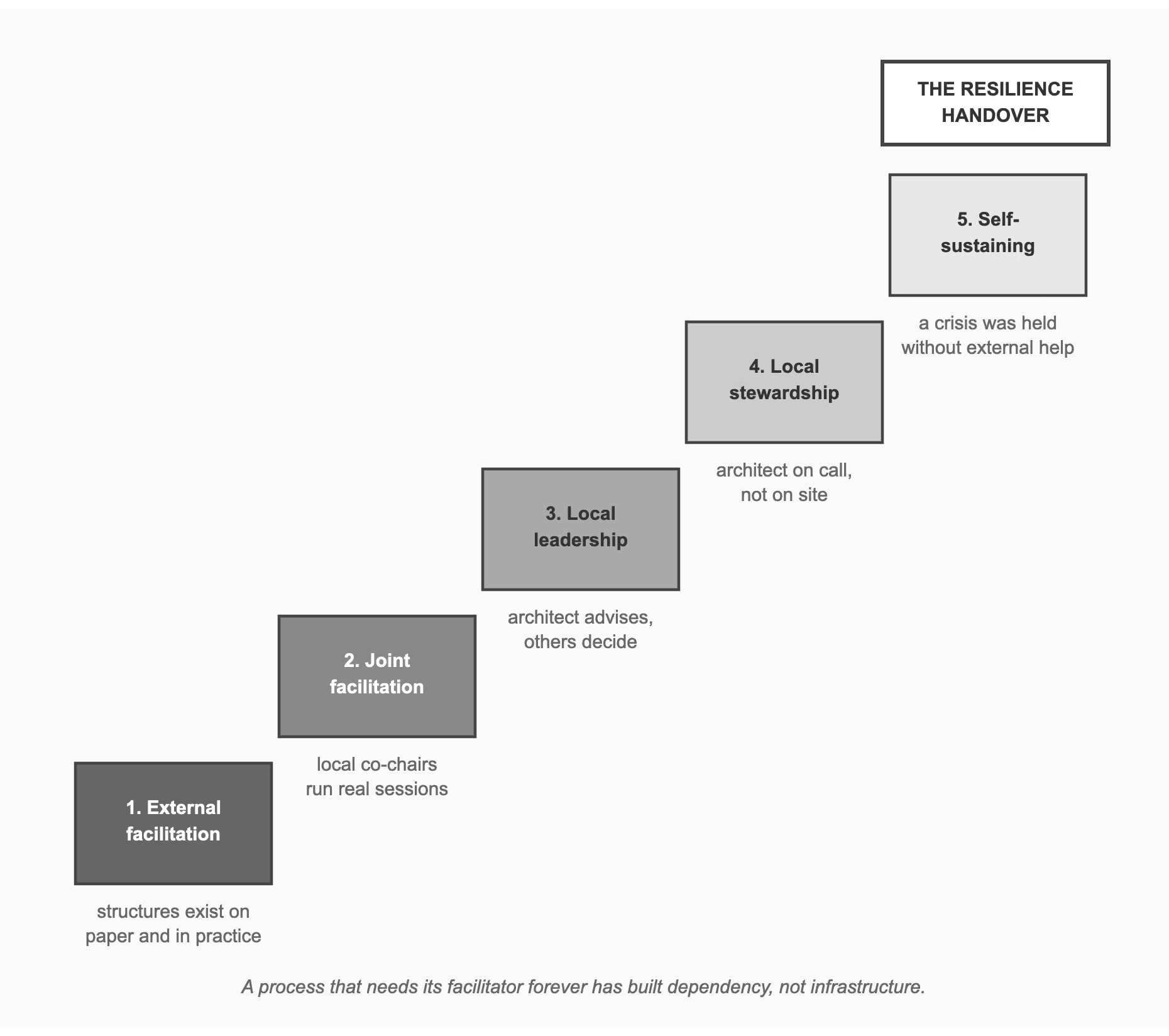
Step one is external facilitation. The practitioner designs, convenes, and runs the process while local actors learn the structures by operating inside them. The test to leave this step is concrete: the council meets on rhythm, the grievance mechanism processes cases, and the registers are kept, all without prompting. The failure smell is competence performing instead of teaching. The practitioner’s structures run beautifully, the meetings are crisp, the paperwork is immaculate, and none of it is transferring. A process that looks best when the facilitator is in the room is failing this step no matter how good it looks.
Step two is joint facilitation. Local co-chairs, one from each side where possible, run real sessions with the practitioner alongside them. The test is that local co-chairs have run consequential sessions, ones where money or conflict was genuinely on the table, and the structure held. The failure smell is ceremonial co-chairing, a local chair holding the gavel while the facilitator’s eyebrows run the meeting. This is why the test specifies consequential sessions rather than any sessions at all. Stakes are the only thing that reveals whether the transfer is real. A co-chair can preside beautifully over a routine agenda while quietly waiting for the facilitator’s cue the moment real money appears.
Step three is local leadership. The roles reverse. Locals decide, the practitioner advises, present but no longer steering. Preparation meetings shift from “here is the plan” to “what is your plan?” The test is deliberately demanding: the practitioner can point to a string of significant decisions the locals made well, against the practitioner’s own advice. The failure smell is obedient independence, locals deciding whatever they sense the facilitator would decide. Independence that only shows up when it agrees with you is not independence, and a facilitator who has never been overruled on something that mattered has not reached this step. They have trained an echo.
Step four is local stewardship. The practitioner leaves the site and remains on call, available for the hard hour but consulted by choice rather than habit. Check-ins thin out, monthly at first, then quarterly, then annual. The test is that routine matters never reach the phone, and the calls that do come are the right ones. The failure smell is the quiet regression: routine calls creep back, each one reasonable on its own, and the dependency rebuilds itself politely. The countermeasure is unglamorous. Log the calls and read the log. A pattern of “small” calls is a step sliding backward while everyone is being polite about it.
Step five is self-sustaining. The accord runs on its own institutions across personnel changes and seasons. There is only one honest test of this step, and it cannot be staged: a crisis is handled without any external help. The failure smell is quiet years mistaken for strength. Nothing certifies self-sustainment except weather. A committee that opens the binder, invokes its own protocol, and resolves a genuine disturbance with the founding facilitator nowhere in sight has passed the only exam that matters, and a run of calm years proves nothing except that the storm has not arrived yet.
That last test is not a metaphor for me. Six years after one of my contracts ended, I visited a site out of curiosity, not invitation. The water committee was meeting, chaired by a woman who had been a junior schoolteacher when I left, and they were working a problem I had never prepared them for: a borehole pump had failed the same week a rumor started that the lake water was poisoning cattle. Old reflexes would have made that a crisis. Instead someone opened the binder, invoked the rumor protocol, called the joint-statement channel, and commissioned a water test from the laboratory the community had chosen years before. The results came back clean, and the pump was replaced from the maintenance fund. Their copy of the accord was on the table, dog-eared and annotated, the spine broken in three places. Nobody in that room needed me. Without anyone calling it that, the crisis they handled that week was their certification exam, and they had passed it.
Partial handover, the three capacity tracks, and the on-call protocol
Two disciplines keep the staircase honest, and skipping either one is how a handover becomes a ceremony with a collapse behind it.
The first is partial handover. Functions transfer at different speeds, and they should. Routine monitoring hands over first, meeting facilitation second, data interpretation later, and crisis response last. A water committee might reach local stewardship two full years before a benefit fund does, because money is always the slowest trust. Track the handover per function, not as a single flag to be planted, and refuse to read the gap as a delay. An accord on step four for its water module while its benefit fund still needs step two attention is not behind schedule. It is being handed over honestly, at the pace each function has earned.
The second is the refusal to skip steps. Pressure to compress the staircase always arrives, from budgets, from the practitioner’s next assignment, from everyone’s fondness for graduation ceremonies. A step skipped is a test unpassed, which is a load rating nobody actually measured. The pace belongs to the evidence, not the calendar. I have seen the climb done well in two years on a site with a contained dispute and existing civic muscle, and honestly take six on another. Rushing buys a ceremony and rents a collapse.
A handover transfers functions, and functions only land where there is capability to catch them. This is why capacity building is not a workshop bolted onto the agreement. It is the load-bearing wall of the whole staircase, and it runs on three tracks. The community track builds negotiation fundamentals: interest-based method, active listening, and reading corporate constraints well enough to draft proposals a company can actually answer. It also builds early-warning recognition, the skill of raising trouble while it is still small enough to handle across a table. The company track builds what corporations chronically lack: cultural humility, cross-cultural communication, and managers who can hear a complaint without reaching for a press statement. The joint track is the strongest of the three. Community and company personnel train together and solve exercises together, because people who have learned side by side build channels that outlast any clause in the agreement.
Capacity building fails in three known ways, and each has a specific remedy. It fails when it is a one-time event, because skills fade without practice, so reinforce it on a rhythm, with annual refreshers and practice built into the ordinary calendar. It fails when it targets the wrong people, chosen for politics rather than for the roles they will hold. The remedy is to select trainees against the handover plan’s function inventory, the person who will actually chair and the person who will actually read the water data, with deputies trained alongside so a single departure does not undo a year. It fails when nothing survives past the honeymoon, so fund the capacity line into year four. The year-four capacity budget is precisely what separates an organization exiting responsibly from one leaving quietly.
The practitioner’s own exit needs the same discipline. Withdrawal is graduated, never abrupt, every function transferred to a named, prepared owner, and exit criteria agreed jointly and in advance, so the leaving is transparent rather than felt as abandonment. The on-call arrangement is codified in writing, in four lines. Its scope is limited to crises and interpretive disputes, not routine business. Its channel and response time are set. Its funding is prepaid from the accord’s budget rather than negotiated mid-crisis, because the worst moment to argue about a facilitator’s fee is the moment the community actually needs one. And its expiry is reviewed, because on-call arrangements are scaffolding too. Asking for help should carry no stigma and no surprise invoice.
This is why the SIMP-inside-a-management-system detail matters. The handover is not to a person. When the schoolteacher chairs that water committee, she is not the point of failure an indispensable facilitator was, because she sits inside a function, a standing monitoring role with a budget, a method, a rhythm, and a trained deputy. If she leaves, the function does not.
How the two pillars reinforce each other
The two pillars are weaker alone, and they produce durability only together. Dual Accountability is what makes the handover credible while it happens: both sides watch the neutrality being engineered through symmetric access and same-day reports, so neither reads the transfer of control as the other side winning. The handover is what makes Dual Accountability permanent: it moves the co-chairing, the symmetric access, and the open decision-making from things the facilitator guarantees into things a local, joint body owns. The mechanics of two-way accountability are the muscles the handover trains. By the time the facilitator reaches step five, the community and the company are running visible neutrality themselves, out of habit, because they have done it under supervision for years.
This is the difference between institutionalization and personal relationship. A personal relationship depends on the specific people in it and decays when they leave. An institution is a set of roles, rules, and rhythms that survives the people who occupy them. The two pillars together convert one into the other: the handover builds the roles and trains the people to fill them, and Dual Accountability writes the rules those roles must follow. It is also why the SAA measures success on a scale rather than a signature. The Impact Load-Bearing rating runs across five levels, from ILB-1, a fractured relationship that bears no load, to ILB-5, self-sustaining and community-stewarded, carrying generational loads. The rating scored at the diagnostic is re-scored at exit, and the distance between the two is the accord’s report card. A handover done well moves a relationship up that scale and leaves it there. A signing ceremony moves nothing and measures nothing.
Why a governance committee on paper is not the same thing
Plenty of agreements already have a governance committee, and most of them are the thing this design is built to outperform. The gap is not the existence of a committee, but whether it has the specific properties both pillars require. A standard committee usually carries three weaknesses, and the two pillars answer each one. Its neutrality is asserted rather than engineered, so when the funding party quietly briefs one side or previews a report, nothing structural stops it. Dual Accountability makes that neutrality checkable through symmetric access, same-day reports, open co-chaired decisions, and the veto, preview, and quiet-channel prohibitions. Its members were chosen for standing rather than for the functions they must perform, so they can preside but cannot run the water data or hold a session where real money is at stake. The three capacity tracks build the committee against the function inventory instead, so its people can do the work rather than only sit for it. And it was created by a signing rather than climbed to through earned tests, so nobody knows its real capacity until a crisis measures it. The staircase measures it earlier, under rising load, before the facilitator leaves. That is the gap between a committee on paper and a committee that has resolved a real crisis on its own, and it only shows on the day you cannot afford to discover it.
A handover done well, and a relationship that decayed
Consider a scenario drawn from patterns across mining agreements that outlived their founders and mining agreements that did not. Two operations, comparable in size, sign comparable community agreements with comparable governance committees in the same year. The documents look almost identical. Five years later they are not.
At the first site, the facilitator treated the exit as the design from day one. Every function had a named local owner and a trained deputy, capacity building ran on all three tracks past year one, and the committee co-chaired and minuted its own decisions while reports went to both sides on the same day. The handover was tracked per function: routine monitoring reached local stewardship in year two, the benefit fund took until year five, and nobody called the gap a delay. When a contractor dispute blew up in year four, the co-chairs resolved it over a weekend and told the facilitator on Monday. By exit, the committee had run visible neutrality under supervision for years. When the asset later changed hands, the new owner inherited a functioning institution with a load-bearing rating that had climbed two measured levels, an asset on the balance sheet rather than a liability waiting to surface.
At the second site, the agreement was built to be signed. The governance committee was real, chosen for standing, and it met on schedule and produced minutes. But neutrality was the facilitator’s personal quality, and when the funding party began briefing the company side before meetings, nothing stopped it. Capacity building was a two-day workshop that never repeated, and there were no trained deputies, so when the committee’s most capable member emigrated the role went vacant. The handover, when it came, was a ceremony: an event, a photograph, a contract that ended on a date. Eight months later the structures were hollow, the company’s champion had transferred, and the first real dispute went straight to the road, because protest was the only enforcement a one-sided agreement had ever left the community. The new owner inherited a document everyone on the ground already treated as dead.
Same industry, same year, same paperwork. The difference was entirely in Phase 4. One agreement was handed to an institution under a two-way accountability regime. The other was handed to nobody, under a neutrality that left with the facilitator.
The failure mode that undoes both pillars at once
One failure deserves its own name, because it corrupts the handover and the accountability together: verification by the party being verified. A facilitator or auditor hired, briefed, and paid by one side produces the finding that side ordered. The report reads like assurance until the first crisis, when it reads like the problem. The community learns the neutral function was captured, and the handover it was meant to inherit is worthless before it arrives. The prevention is structural rather than ethical. The joint governance body commissions and receives all verification, its funding is a standing line in the accord’s budget rather than an annual discretionary item, and the veto, preview, and quiet-channel prohibitions hold whoever is paying. A neutral function that answers to one side is not a handover in progress. It is a capture with a schedule.
Where these pillars sit inside the Social Accord Architecture
The SAA runs in four phases: Diagnostic Mapping surveys the ground, Blueprinting designs the process, Assembly builds it into living structure, and Stewardship and Scaling maintains it to independence. The Resilience Handover, Instrument 4.2, belongs to that fourth phase, and everything the earlier phases build, the actor map, the trust audit, the shared intent, the mechanism design, the modular agreements, the governance council, is precisely what decays on the standard schedule if Phase 4 does not exist. A blueprint without a handover is a design for a structure that depends forever on its architect standing underneath it.
Dual Accountability sits slightly differently, because it is one of the five principles that govern every phase, not only the fourth. It is present from the first diagnostic interview, in whose access is symmetric and whose funding is disclosed, and it runs through to the final handover, where its mechanics become the muscles a local body must own. It is in Phase 4, though, that the two ideas fuse into durability, because here the process stops depending on the practitioner and starts depending on structure. Success is measured on the day a committee handles a crisis with the founding facilitator nowhere in sight, not on the day of the signing ceremony.
Stage the handover on tests, not dates
The tool for this article is a roadmap, not a checklist, because a handover is a sequence you climb rather than a set of boxes you tick. The Resilience Handover Roadmap lays out the five staircase steps as sequential phases: external facilitation, joint facilitation, local leadership, local stewardship, and self-sustaining. For each, it names the readiness test that must be genuinely passed before you climb, and the failure smell that signals a counterfeit step, from ceremonial co-chairing at step two to obedient independence at step three. Underneath the staircase it carries the disciplines that hold it up: the three capacity tracks, the partial-handover rule that tracks each function separately, and the codified on-call protocol with its prepaid funding. Eighteen numbered elements in all, across the five steps and the foundation beneath them. Use it to mark where each function of your accord currently sits, then plan the next readiness test instead of the next date, so what you leave behind is a structure that stands rather than a dependency wearing a graduation gown. Download the Resilience Handover Roadmap
Why a mediated structure outlasts a signed deal
A signed deal is a snapshot of one moment’s willingness. A durable accord is an institution that keeps both parties honest after that willingness fades, and building an institution is mediation work, not drafting work. Independent, structured facilitation is what makes the handover credible, because both sides can watch the neutrality being engineered rather than being asked to take it on faith. It is also what makes the two-way accountability real, because a neutral third party is the only one positioned to hold symmetric access and same-day reporting while the parties learn to hold it themselves. The reactive alternative is a company managing the relationship alone until the next protest forces a renegotiation, which teaches the community that pressure is the only thing that works, and guarantees the next crisis.
The Social Accord Architecture is the structured way to build for durability from the first day rather than hoping for it at the end. Within the SAA, the Resilience Handover designs the practitioner out of the job on earned tests rather than convenient dates, so the accord survives every departure. Dual Accountability, its second principle, keeps both the company and the community bound to their commitments through a governance body that answers to both at once. Neither works without the other. A handover without two-way accountability transfers a rigged machine; two-way accountability without a handover dies with its facilitator. Together they turn a relationship that would decay with its founders into an institution that outlives them. If you are designing an agreement you want to still be standing in a decade, and running under its own power when the people who signed it have moved on, reach me at thomas@thomasgaultier.com.